
THE YÁRÁN-I-IRÁN
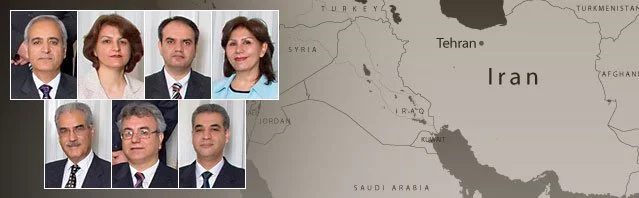
Although this book is about the solitary months of Mahvash Sabet’s imprisonment, there was never a moment during this period when she was not thinking of the six other members of the Yárán-i-Irán. Yárán (meaning Friends) was an ad hoc group established in 1984 that served as the temporary leadership committee for the social and spiritual needs of the Bahá’í community in Iran, of which Mahvash was its secretary. She feared for her dearly loved colleagues from the minute she was arrested. She agonized over the pressure they might be under due to her detention, and she guessed, in the end, that they were suffering just as she was. So it seems appropriate to acknowledge each member briefly, by name.
Mahvash’s closest companion in prison was the only other woman in the group, Faribá Kamalábádi. Born in Tehran on 12 September 1962, Faribá is no stranger to persecution. In her youth, she witnessed her father’s imprisonment and torture, when he was fired from the government health service in the 1980s and, after graduating from high school with honours, she too was debarred from university because she was a Bahá’í. In her mid-thirties, she embarked on eight years of informal study culminating in an advanced degree in developmental psychology from the Bahá’í Institute of Higher Education (BIHE). Her two sons left Iran to live and work abroad, but her youngest daughter was still in school at the time of her arrest. Faribá was deprived of attending her daughter’s wedding as well as the birth of her first grandchild. She too was arrested again in July 2022 and condemned to another ten years imprisonment, with Mahvash.
Many of the prisoners who met these two women during their first ten years in Evin were profoundly affected by them. The journalist, Roxana Saberi, who shared a cell with them, stated in an interview: “Faribá and Mahvash were two of the women prisoners I met in Evin who inspired me the most…. They showed me what it means to be selfless, to care more
about one’s community and beliefs than about oneself.”
The third person mentioned in these pages is the most senior member of the Yárán, Jamaloddin Khánjání. Born 27 July 1933 in the city of Sangsar, Mr. Khánjání grew up on a dairy farm in Semnan province and never obtained more than a high school education. Yet his dynamic personality soon led to a successful career, and the brick-making factory he established was the first of its kind in Iran, employing several hundred people. In the early 1980s, he was forced to shut it down, and the factory was later confiscated by the government. Arrested three times before his sentencing as a member of the Yárán in 2008, Mr. Khánjání was once again imprisoned, in August 2023, along with his daughter. Over ninety years old and in fragile health, he was released after paying an exorbitant bail.
A fourth member of the now-disbanded Yárán, who is in prison again at the time of this writing, is Afíf Naemí. Born on 6 September 1961 in Yazd and raised after his father’s death by his uncles in Jordan, he learned Arabic in elementary school but was unable to pursue his dream of becoming a doctor when he returned to Iran. Denied access to a university education as a Bahá’í, he diverted his attention to business, taking over his father-in-law’s textile factory in the early 1980s. Like Mahvash and Faribá, Mr. Naemí was arrested again in July 2022 and condemned to a second ten-year sentence.
The fifth member of the Yárán is Behrouz Tavakkolí. Born on 1 June 1951 in Mashhad, Mr. Tavakkolí studied psychology at university and then completed two years in the army, where he was a lieutenant. After his marriage, he undertook additional training to specialize in the care of the physically and mentally impaired, holding a government position as a social worker until he was fired due to his faith in the early 1980s. Prior to his imprisonment in 2008, he had already experienced intermittent detainment and frequent harassment and was jailed for four months without charge in 2005, spending most of that time in solitary confinement. To support himself and his family, Mr. Tavakkolí established a small carpentry shop in Gonbad where he also conducted classes in Bahá’í studies for adults and young people. His two sons were educated through the BIHE, and he himself had served in several Bahá’í institutions before these were banned in the 1980s. Like Mr. Khánjáni, he was a member of the Yárán from the late 1980s until the group was disbanded.
The sixth member of the Yárán was Saeíd Rezáíe, an agricultural engineer known for his scholarship and poetry. The author of several books on Bahá’í topics, he inspired Mahvash to start writing poems by slipping a tiny verse into her hand when they met briefly during visiting hours in prison. Born in Abadan on 27 September 1957, Mr. Rezáíe spent his childhood in Shiraz, and after completing high school with honours, obtained a degree in agricultural engineering from Pahlavi University in that city. After his marriage in 1981, he became a farm manager at a time when persecution of Bahá’ís was particularly intense and opened an agricultural equipment company in Fars Province in 1985 that won wide respect in the region before being forcibly closed down. He later moved to Kerman, working as a carpenter and doing other odd jobs as Bahá’ís faced increasing economic strangulation. Before his arrest as a member of the Yárán, he had already experienced detention in 2006 and forty days in solitary confinement. His two daughters were among fifty-four Bahá’ís arrested in Shiráz in May 2006 while engaged in a project for underprivileged youth.
Finally, the youngest and last member of the Yárán, Vahíd Tizfahm, was born 16 May 1973 in Urmia, Iranian Azerbaijan. After receiving a high school diploma in mathematics, he became an optician in Tabríz where he later owned an optical shop and studied sociology. He was married at the age of twenty-three and had one son, who was only nine years old at the time of his arrest in 2008. Mr. Tizfahm served the Bahá’í community enthusiastically before all Bahá’í institutions were disbanded. At one time he was an eager, fervent member of the Bahá’í National Youth Committee and later was appointed to the Auxiliary Board, an advisory group at the regional level. He also taught local Bahá’í children’s classes before being appointed to the Yárán in 2006.
Since the dissolution of the Yárán in 2008, the persecution of the Iranian. Bahá’í community has continued unabated. But in spite of all the false charges against them, they have responded with a quiet dignity and a refusal to be victimized. Nor has their determination to work for the progress of their country diminished. In an open letter addressed to the Iranian Bahá’ís on 23 August 2022, the Universal House of Justice defined the high standard of behavior they have been called upon to characterize, ideals which – as her memoir attests – have surely inspired Mahvash Sabet:
The Bahá’ís seek justice and long for fairness and equity but never pursue retaliation and revenge. … They are driven out of their homes but are a shelter and refuge to others…They are wronged but are the well-wishers of those who wrong them. .. Beloved friends! … bring hope to your countrymen’s hearts. Be a source of consolation to every burdened soul and of confidence to every weary heart. Care sincerely for everyone and bring solace to every helpless one. Heal the pains of others and thereby ease your own pain. And before Almighty God ask forgiveness for those who commit iniquity against you and pray fervently that the dross of prejudice and ignorance may be cleansed from their hearts.
A. Mottahedeh and B. Nakhjavani, Adapted from “Postscript and the Yárán of Iran”; OPEN WIDE THE DOORS: A Memoir of Faith, Hope, and Freedom in Iran by Mahvash Sabet, pages 386-291; Copyright © 2026 (Oneworld Publications, Ltd., London, UK).